When most people think of fencing, they picture a neat garden boundary or a closeboard panel going up beside a patio. Agricultural fencing is a completely different discipline, and after years of working on farms, smallholdings and rural plots across South Devon, we've learned that getting it wrong can be costly in ways that go well beyond aesthetics. A failed garden fence is an inconvenience. A failed stock fence means escaped livestock, neighbour disputes, and potentially a serious welfare issue.
In this guide, we'll walk through everything we've learned about agricultural fencing in this part of the world, from the types of fencing that suit different livestock to the specifics of working on South Devon's notoriously undulating terrain. Whether you're running a commercial sheep flock on the land between Newton Abbot and Totnes, keeping a few pigs on a smallholding near Kingsbridge, or managing cliff-top grazing above Shaldon, this should give you a solid grounding before you pick up the phone.
Why Agricultural Fencing Is a Different Discipline
Residential fencing is primarily about privacy, security and appearance. Agricultural fencing is about containment, safety and durability in conditions that would destroy a garden fence inside a year. The loads are different. A bullock leaning on a fence applies a very different force to a fence panel than the wind does. The ground conditions are different too. You're rarely working off a level lawn with decent topsoil. More often it's a wet field, a hedge bank, a stone-faced Devon bank, or a slope that makes post-hole digging a genuinely physical challenge.
The materials are heavier, the posts are larger, and the construction method is fundamentally different. A wire fence lives or dies on the strength of its strainer assemblies, not on the line posts in between. Get the strainers right and the fence will last decades. Get them wrong and you'll be back out in the field with a wire strainer and a bad temper within two winters.
Agricultural fencing also has to work with the landscape rather than against it. Across Torbay and the South Hams, that means integrating with hedgerows, negotiating Devon banks, dealing with coastal salt exposure, and handling the wet, heavy clay that sits on top of much of the limestone around here. There's no one-size-fits-all solution, which is why we always come out to survey a site before quoting.
Types of Agricultural Fencing
Stock Fencing
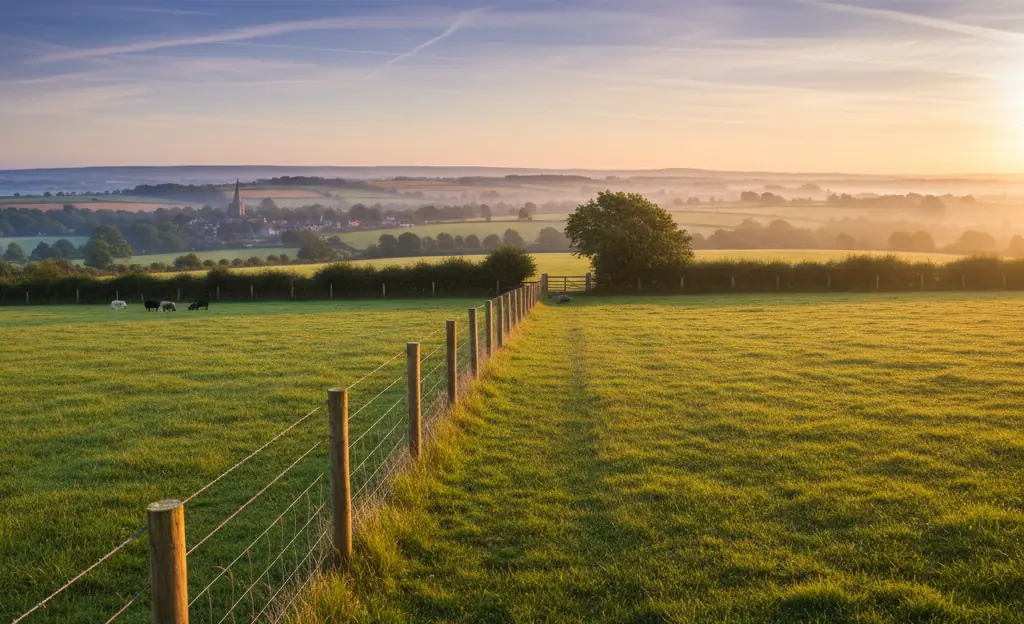
Stock fencing is the workhorse of British agriculture. It consists of wire mesh netting strained between timber posts, and it's what you'll see bounding the majority of fields across Devon. The mesh is manufactured in different heights and hole sizes to suit different livestock, and choosing the right specification matters.
For sheep, we typically install stock netting at 90cm to 105cm height. The mesh needs to be tight enough at the base to prevent lambs from pushing through, and the wire should be high tensile so it can be strained properly without sagging. Cattle require a heavier duty setup, with larger section posts and often a plain wire or barbed wire top line to discourage animals from leaning over and pushing the fence down.
For pigs, the requirements step up again. Pigs are extraordinarily strong and will test every weakness in a fence. We use heavy duty stock netting, often with a lower height but a thicker gauge wire, and we frequently add an electric top wire to teach them respect for the boundary. Pigs will also root underneath, so burying the base or turning it outward can help.
The key to good stock fencing is tension. The netting has to be strained tight between strainer posts so it acts as a single sheet. If it's loose, livestock will push through it and the mesh will deform permanently. We use proper wire strainers and always check the tension is consistent across the run.
Post and Rail Fencing
Post and rail is the traditional, attractive option that you'll see lining driveways to farmhouses, bounding horse paddocks, and marking the edges of properties where appearance matters as much as function. It's constructed from timber posts with horizontal rails, usually two, three or four depending on the application and the height required.
For horses, post and rail is the gold standard. Horses need to be able to see their boundary clearly, and they need a fence that won't injure them if they lean against it or spook into it. We use rounded or chamfered rails with no sharp edges, and we set the height according to the size of the horses, typically around 1.2m to 1.4m for standard stock. The rails need to be securely fixed to the posts so they don't come loose under pressure.
Post and rail is also excellent for driveway entrances and boundary markers where a client wants something that looks smart but is still genuinely robust. Treated timber, properly installed, will last 15 to 20 years even in exposed conditions. We've installed post and rail on properties from Torquay out to Dartmouth where the salt air is a real factor, and the treatment specification has to account for that.
Deer Fencing
Deer fencing is a taller, heavier mesh fence, usually 1.8m or higher, designed to keep deer out of forestry plantations, orchards, and high-value crops. The mesh is similar to stock netting but taller and with a smaller hole size at the base. The same strainer assembly principles apply, but the taller the fence, the greater the wind load, so the strainer posts need to be correspondingly larger and set deeper.
In South Devon, deer fencing is most commonly needed on the Dartmoor fringe and in the wooded valleys around the South Hams, where roe and fallow deer populations are healthy and will happily strip a young plantation bare if given the chance. If you're planting trees or running a market garden in these areas, deer fencing is worth considering from the outset. Retrofitting it after the deer have found you is always more expensive.
Electric Fencing
Electric fencing is the flexible, cost-effective option for rotational grazing and temporary paddock divisions. It can be permanent, using wooden posts with insulators and high tensile wire, or temporary, using plastic posts and polywire or polytape. The principle is the same in both cases: a pulsed electric current delivered through the fence wire conditions the animal to respect the boundary.
For rotational grazing systems, which are increasingly popular across Devon as regenerative farming practices spread, temporary electric fencing is invaluable. It lets you divide a large field into smaller paddocks and move stock frequently, which improves pasture health and reduces parasite burdens. We install permanent electric fence systems with proper earth stakes and energisers, and we also advise smallholders on setting up their own temporary systems if they want to manage that themselves.
The critical thing with electric fencing is the earth system. A poor earth connection is the single most common reason an electric fence stops working. The earth stake needs to be driven into moist soil, and in dry summers across South Devon's free-draining fields, that can mean a longer earth stake or multiple stakes in series.
Rabbit Fencing
Rabbit fencing is the specialist option for protecting crops, gardens and young plantations from rabbit damage. It uses a finer mesh, typically 31mm hole size, and it has to be buried or turned out at the base to prevent rabbits from digging underneath. Rabbits will dig, and they will find any gap.
We install rabbit fencing either as a standalone fence or as an addition to an existing stock fence. The buried section is usually 15cm into the ground, turned outward, and the above-ground height is around 75cm to 90cm. In areas with heavy rabbit pressure, particularly on the field margins around Totnes and the South Hams, this can save a market gardener an entire season's crop.
Choosing the Right Fencing for Your Livestock
The right fence depends on what you're keeping, how many, and on what ground. Here's a quick reference based on what we install most often across Devon:
Sheep: Stock netting at 90cm to 105cm height, high tensile wire, timber line posts at 2m to 3m spacing. Strainer assemblies at every corner and direction change. A plain wire top line is optional but useful for keeping sheep from leaning over.
Cattle: Heavier section posts, high tensile stock netting or a combination of plain wires, often with a barbed wire top line. Cattle are hard on fences, so the strainer assemblies need to be substantial. Post and rail is an option for boundary fencing where appearance matters.
Horses: Post and rail with visible, rounded rails and no sharp edges. Heights of 1.2m to 1.4m depending on the size of the horses. Electric fencing with wide polytape is also popular for temporary divisions, as horses can see it clearly. Avoid barbed wire entirely around horses.
Pigs: Heavy duty stock netting, often with an electric top wire to stop them rooting over. The base may need burying or turning out. Posts need to be close-set and well driven, because pigs will test every post individually.
Poultry: Finer mesh, typically 25mm to 50mm, to prevent birds slipping through and to keep foxes out. The base should be buried or skirted outward to stop foxes digging in. A covered run or a top wire may be needed where buzzards and other raptors are a problem.
Post Specifications and Timber Treatment
The timber is the foundation of any agricultural fence, and cutting corners here is a false economy. We use pressure-treated timber for all agricultural work, with treatment to Use Class 4 as a minimum. For posts that will be in constant ground contact, which is all of them, this treatment process forces preservative deep into the timber under pressure, giving a service life of 15 years or more.
Line posts for stock fencing are typically 75mm to 100mm in diameter, or 75mm x 75mm if square sawn. Strainer posts are larger, usually 125mm to 150mm diameter, because they carry the entire tension of the wire run. The bigger the fence, the bigger the strainer. For deer fencing at 1.8m, we'd be looking at 150mm strainers as a minimum, set at least 75cm into the ground.
Timber should be sourced from sustainably managed forests, and all our timber is. It should be stored properly before installation, not left sitting in mud, and it should be installed with the grain orientation considered. A post that's split at the top will rot faster, so we cap or angle-cut tops where appropriate.
Strainer Assemblies: The Backbone of Any Wire Fence
If there's one thing we'd want every farmer and smallholder to understand, it's the importance of strainer assemblies. These are the anchor points that take the entire strain of the wire, and they are what separates a fence that lasts 20 years from one that's sagging by next spring.
A strainer assembly consists of a strainer post, a stay post (the diagonal brace that pushes against the strainer), and the straining wire that ties them together. The strainer post is set deep, the stay is cut to bear against it at a 30 to 45 degree angle, and the assembly acts as a rigid triangle that won't move when the wire is strained.
We install strainer assemblies at every corner, every change of direction, every gatepost, and at intervals along long straight runs, typically every 200 metres for stock fencing. The spacing depends on the ground and the fence type. On a straight run across flat ground, you can go further between strainers. On a hilly South Devon field with frequent direction changes, you'll have strainer assemblies every 50 metres.
The stay can go on either side of the strainer, depending on the direction of the strain. On a corner, both legs of the corner need staying. On a dead-end where the fence meets a wall or hedge, the strainer assembly takes the full load in one direction. Getting this right is the difference between a fence that holds and one that pulls over.
Gates for Agricultural Use
A fence is only as good as its gates, and agricultural gates take a lot of punishment. Field gates are typically 3m to 4.5m wide for vehicle access, with smaller pedestrian gates where needed. The choice between metal and timber comes down to the application.
Metal field gates, usually galvanised steel, are the standard for field access. They're strong, weather-resistant, and will take a tractor brushing past without complaint. Timber gates are more common for pedestrian access and for locations where appearance matters, such as the entrance to a farmhouse drive. We hang both types, and the hanging is where the quality shows.
A gate needs substantial gateposts, larger even than strainer posts, set deep and well braced. The hinges need to be heavy duty and properly aligned, and the latch needs to be operable from horseback or from a vehicle. We use specific agricultural gate furniture, not residential fittings, because the loads are completely different. A gate that sags on its hinges is a gate that won't latch, and a gate that won't latch is a gap in your fence.
Maintaining Agricultural Fencing
A well-built agricultural fence is low maintenance, not no maintenance. We recommend an annual check of all strainer assemblies, looking for movement in the posts or cracking in the stays. Any strainer that's moving needs attention before it fails completely, because once a strainer goes, the whole run of wire loses tension and the fence is compromised.
Wire tension should be checked each spring. High tensile wire holds its tension well, but ground movement, livestock pressure and temperature changes can all cause gradual slackening. A few minutes with a wire strainer can save a fence that's otherwise on its way out.
Damaged posts should be replaced promptly. A broken line post creates a weak point that livestock will find and exploit. Vegetation control along the fence line is also important. Brambles and nettles growing through wire fencing will eventually pull it out of shape, and in the worst case they can hide damage that you'd otherwise spot. A flail or strimmer pass once or twice a year keeps the fence visible and serviceable.
Planning Considerations
The good news is that most agricultural fencing falls under permitted development and doesn't require planning permission. You can erect, maintain or replace fences on agricultural land without applying to the local authority, provided the land is used for agriculture and the fence is necessary for that use.
There are exceptions. Fencing over 2m high, or over 1m high adjacent to a highway used by vehicles, may need permission. If your land is in a conservation area, the South Devon Area of Outstanding Natural Beauty, or a Site of Special Scientific Interest, there may be additional restrictions. The SSSI designations that cover parts of the South Hams coastline, for example, can affect what you're allowed to do on cliff-top grazing. If in doubt, check with Torbay Council or Devon County Council before proceeding, and we're always happy to advise on the practicalities.
Cost Considerations and Grants
Agricultural fencing is priced per metre for the fencing itself, plus additional costs for strainer assemblies, gates, and any ground preparation needed. The final cost depends on the fence type, the ground conditions, the access for machinery, and the length of the run. As a rough guide, stock fencing is the most economical per metre, with post and rail and deer fencing costing more due to the materials and labour involved.
It's worth knowing that funding may be available. The Countryside Stewardship scheme, administered by the Rural Payments Agency, can offer grants for certain types of fencing that deliver environmental benefits, such as fencing to exclude livestock from watercourses or to manage grazing on species-rich grassland. If you're running land in the South Hams or on the Dartmoor fringe, it's worth checking whether your fencing plans might qualify. The application process takes time, so it's best to look into this well before you need the fence installed.
South Devon Specifics
Working across Torquay, Paignton, Brixham and the surrounding rural areas gives us a real feel for the local conditions, and they do shape how we approach a fencing job. The hilly terrain across much of the South Hams means we're frequently fencing on slopes, which affects post depth, strainer placement and wire tension. On a steep slope, the wire naturally wants to pull downhill, so the uphill strainer assemblies carry more load and need to be built accordingly.
Hedgerow integration is a big part of agricultural fencing in Devon. Many field boundaries here are hedge banks, often stone-faced, and the fence typically runs along the top or the toe of the bank. We work with the existing hedge rather than clearing it, because those hedges are valuable for wildlife, windbreak and stock shelter. Fencing along a hedge bank often requires shorter posts on the bank top and careful setting to avoid disturbing the hedge roots.
Coastal exposure is a real factor for cliff-top grazing around Shaldon, Stokeinteignhead and the coastal path land above Torbay. Salt-laden wind accelerates timber weathering and corrodes metal fittings, so we specify marine-grade galvanised fittings and timber treatment suited to exposed conditions. We also factor in the wind load on taller fences in these locations, which means closer post spacing and more substantial strainers.
The Dartmoor fringe, running up through Newton Abbot and beyond, presents its own conditions. The ground can be wet and heavy, with peaty topsoil over clay, which means posts need to be set deeper to get a solid hold. The temperature range is wider than on the coast, with harder frosts in winter that can heave posts out of the ground if they're not set below the frost layer.
Every area has its quirks. The flat, drained land around Kingsbridge is different again from the steep valleys above Dartmouth. We've worked in all of these places, and we adjust our approach to suit. That's the value of using a local contractor who knows the ground.
Final Thoughts
Agricultural fencing is an investment in your land and your livestock, and it's worth doing properly the first time. The difference between a well-built fence and a cheap one isn't just in how long it lasts, it's in how much grief it saves you along the way. A fence that holds stock securely, year after year, through wet winters and exposed summers, is a fence that pays for itself in peace of mind.
If you're planning a fencing project, whether it's a single field boundary or a full farm refence, we'd rather come out and have a look before we quote. That way we can see the ground, understand what you're keeping, and specify the right materials and method for the job. We work across Torquay, Paignton, Brixham, Torbay, Newton Abbot, Totnes, Kingsbridge, Dartmouth, Shaldon, Teignmouth and the wider South Hams area.
Related services: Agricultural Fencing and our full range of fence services.
To talk through your project, contact Joe on 01803 494348 or visit our contact page and we'll come out to take a look.