School Security Fencing in Devon: Safety, Compliance, and Best Practice
If you are responsible for a school site in Devon, whether you are a headteacher, a school business manager, or part of a local authority facilities team, your perimeter fencing is one of the most important safeguarding decisions you will make. It is not simply a matter of keeping intruders out. School fencing has to keep children safely in, allow staff to supervise effectively, look welcoming to parents and the community, and meet a web of regulatory expectations that go well beyond what a normal commercial site has to deal with.
We have been installing school fencing across Torquay, Paignton, Brixham, Newton Abbot, Totnes, and the wider Torbay area for years, and in that time we have learned that no two school sites are the same. A nursery in Torquay has very different requirements from a secondary school in Newton Abbot, and the fencing has to reflect that. This guide brings together everything we have learned about school security fencing in Devon, so you can make informed decisions about your own site.
Why School Fencing Is Different from Other Commercial Fencing
Most commercial fencing is designed with a single purpose: stop people getting in who should not be there. A warehouse, an industrial estate, or a utilities compound does not have to worry about the welfare of the people inside. School fencing has to do both jobs at once, and it has to do them in a way that supports the daily life of the school rather than working against it.
The first difference is safeguarding. Under the statutory guidance that governs schools in England, keeping children safe is the overriding priority. That means your fencing is not just a physical barrier, it is part of your safeguarding infrastructure. It has to prevent unauthorised entry by people who should not be on the site, and it has to prevent children, particularly younger children, from wandering off the site and into danger. A fence that is secure against intruders but has gaps underneath, or gates that do not self-close, can fail on the safeguarding side just as surely as a fence that is too low to stop an intruder.
The second difference is supervision. School staff need to be able to see what is happening on the perimeter. A fence that blocks the view might be very secure, but it creates blind spots where bullying, unauthorised meetings, or other safeguarding concerns can go unnoticed. This is one of the reasons we generally recommend fencing with good visual transparency for schools, rather than solid panels.
The third difference is appearance. A school is part of a community. Parents bringing their children to a Torquay primary school in the morning should not feel like they are dropping them off at a prison. The fencing has to be secure enough to do its job, but it also has to look appropriate for an educational setting. This is a balance we work hard to get right on every school project.
The Regulatory Framework for School Fencing in England
Schools in England operate under specific statutory duties around site security, and fencing is a key part of meeting those duties. The most important document is Keeping Children Safe in Education, the statutory guidance issued by the Department for Education. This guidance places clear responsibilities on schools to maintain a safe site, and a secure perimeter is a fundamental part of that.
The guidance does not specify exact fence heights or materials, but it does require schools to have appropriate arrangements in place to manage site security. That includes controlling access to the site during the school day, preventing unauthorised entry, and ensuring that children are kept safe while on the premises. If an incident occurs and it turns out the perimeter was inadequate, the school's leadership can be held accountable.
For maintained schools in Devon, the local authority also has responsibilities around site safety and may have its own standards for perimeter security. Academies and free schools, which manage their own estates, will need to satisfy their trustees and the Education and Skills Funding Agency that their sites are secure. Independent schools are inspected by the Independent Schools Inspectorate, which also looks at site security as part of safeguarding.
In practical terms, this means that when we install or replace school fencing, we are not just building a fence. We are helping the school demonstrate that it takes its safeguarding duties seriously. We always recommend that schools document their fencing decisions, including risk assessments and the reasons for choosing particular heights and materials, so there is a clear paper trail if questions are ever asked.
Types of Fencing Suitable for Schools
Not all fencing is suitable for schools, and the right choice depends on the age of the children, the location of the site, and the specific risks you need to manage. Here are the main options we work with for schools across Devon.
Mesh Fencing
Mesh fencing is by far the most common choice for schools, and for good reason. It offers excellent security combined with good visibility, which means staff can see through the fence to supervise the perimeter and spot anyone approaching the site. The mesh is difficult to climb because there are no horizontal rails to use as footholds, and the close spacing of the wires makes it hard to get a grip.
For schools, we particularly recommend 358 anti-climb mesh, sometimes called prison mesh. Despite the unfortunate nickname, it is an excellent product for educational settings. The mesh spacing is very tight, which makes it virtually impossible to get fingers or toes in to climb, and it is extremely difficult to cut through. It is also visually unobtrusive from a distance, so it does not make a school look like a high-security compound. We have installed mesh fencing at schools across Torbay and it is usually our first recommendation for secondary schools and larger primary sites.
The other advantage of mesh fencing is that it works well with modern access control systems. Panels can be fitted with gates that integrate with intercoms, keypads, and fob entry systems, which is essential for managing visitor access during the school day.
Bow-Top Fencing
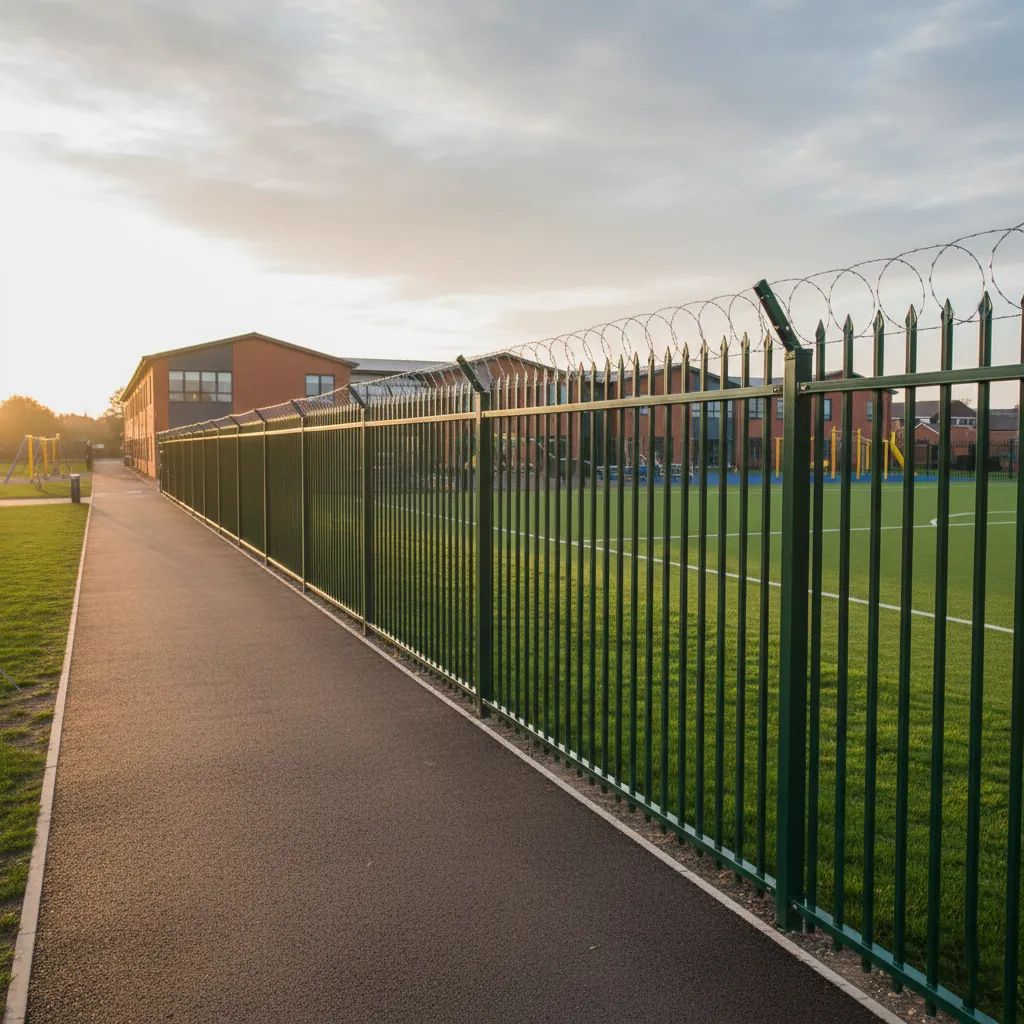
Bow-top fencing is a popular choice for primary schools, nurseries, and early years settings. It has a softer, more decorative appearance than mesh or palisade, with curved hoop tops that look more welcoming while still providing a secure boundary. The spacing between the vertical bars is designed to prevent children getting their heads stuck, and the rounded tops mean there are no sharp points that could cause injury.
We have installed bow-top fencing at a number of primary schools and nurseries in Torquay and Paignton, and it is often the choice that best balances security with the need to create a friendly, approachable environment for younger children. Parents respond well to it because it looks like a school fence rather than a security fence, while still doing the job of keeping children safely on the site and discouraging casual intrusion.
Bow-top is available in a range of heights and can be powder-coated in colours that complement the school's branding or blend in with the surroundings. Green is the most common choice in Devon, as it sits well against the trees and green spaces that many of our local schools enjoy.
Anti-Climb Fencing Variations
Anti-climb fencing covers a range of products designed specifically to make climbing difficult or impossible. The 358 mesh we mentioned above is the most common form, but there are other variations including panels with rolled tops that make it physically impossible to get over without equipment, and systems that combine mesh with additional security features.
For schools in higher-risk locations, perhaps those near town centres or with a history of vandalism, anti-climb variations can provide an extra layer of security without the aggressive appearance of palisade. We would always discuss the specific risks with the school before recommending a particular system, because over-specifying can be just as much of a problem as under-specifying.
Why We Generally Do Not Recommend Palisade Fencing for Schools
Palisade fencing, with its distinctive vertical steel pales and threatening pale tops, is a common sight on industrial sites, railway land, and commercial compounds. It is effective at what it does, but we almost never recommend it for schools, and here is why.
First, the appearance. Palisade looks aggressive. It sends a message that the site behind it is dangerous or under threat, which is not the message a school wants to send to its community. We have seen schools in Devon where palisade has been installed and parents have commented that it makes the school feel unwelcoming.
Second, the injury risk. The pale tops on palisade fencing, whether they are the traditional pointed shape or the slightly blunter variants, present a genuine hazard. Children climb fences, that is a fact of life, and a child climbing palisade fencing is at real risk of impalement or serious laceration. We are not aware of a serious incident at a Devon school, but the risk is well documented in the fencing industry and it is simply not worth taking.
Third, palisade does not offer the visual transparency that schools need for supervision. The pales are close enough together to block a clear view, which creates blind spots along the perimeter.
There are rare situations where a school might need a short run of palisade, perhaps protecting a specific high-risk area like a plant room or a bin store, but for the main perimeter we would always steer schools towards mesh or bow-top alternatives.
Height Considerations for School Fencing
Fence height for schools is not a one-size-fits-all decision. The general range we work with is 1.8 metres to 2.4 metres, and the right height depends on several factors.
For most primary schools in Devon, 1.8 metres is usually sufficient. This is high enough to deter casual intrusion and to keep young children safely within the grounds, while not being so high that it looks oppressive. Younger children are not generally going to attempt to climb a 1.8 metre fence, and the main risk is unauthorised entry rather than children leaving the site.
For secondary schools, we typically recommend 2 metres to 2.4 metres. Secondary school pupils are older, more agile, and more likely to attempt to climb a fence, either to leave the site during the day or in response to peer pressure. A higher fence also provides better deterrence against intruders, which is a more significant concern for secondary sites that may be larger and have more points of access.
Nurseries and early years settings can often work with slightly lower fencing, around 1.2 metres to 1.5 metres, particularly for internal boundaries within a larger site. However, the external perimeter still needs to be secure, and we would usually recommend at least 1.8 metres for the boundary with public land.
The location of the school also matters. A school in a quiet residential area of Totnes may face different risks from one in the busier centre of Torquay or Paignton. We always carry out a site-specific risk assessment before recommending a fence height, because getting this wrong in either direction creates problems. Too low and the fence fails to do its job. Too high and you create a fortress mentality that works against the school's relationship with its community.
Gates and Access Control for Schools
The fencing is only as good as the gates, and for schools the gates are where most of the daily management happens. A well-designed gate system allows the school to control who comes in and out during the day, while keeping the perimeter secure.
All pedestrian gates on a school site should be self-closing and self-latching. This is not optional. A gate that is left open, even for a few minutes, creates a safeguarding gap that could allow a child to leave the site or an unauthorised person to enter. We fit hydraulic self-closing mechanisms that are reliable in all weather conditions, which is important given the salt air and damp that schools in Torbay have to contend with.
Vehicle gates need to be secure during school hours but accessible to emergency services. This is a specific requirement that is sometimes overlooked. If a fire engine or ambulance needs to get onto the site, they should not have to wait for someone to find a key. We can fit emergency access systems that allow the emergency services to open gates using a standard key, while keeping the gates secure against unauthorised use at all other times.
For the main entrance, most schools in Devon now operate a system where visitors are routed through a single controlled access point, usually the reception area. The fencing has to support this by funnelling all visitors to that point, rather than allowing access through multiple gates. This might mean locking some gates during the school day and only opening them at drop-off and pick-up times.
Access control systems, including intercoms, keypads, and fob entry, can be integrated with the gates to manage staff access and visitor entry. We work with the school's existing systems where possible, or can recommend compatible systems if new gates are being installed.
Balancing Security with a Welcoming Appearance
This is the challenge that comes up on every school fencing project we undertake in Devon. How do you make a site secure without making it look like a prison?
The answer is partly about material choice, which we have covered above, and partly about design. A few principles we follow:
First, use colour carefully. Green powder-coating on mesh or bow-top fencing helps it blend into the landscape, particularly in Devon where many school sites have mature trees and green boundaries. Black is a more modern, urban look that works well for secondary schools and sites in town centres. We would not usually recommend bright colours for main perimeter fencing, though they can work well for internal divisions within a site.
Second, think about the entrance. The main entrance is the first thing parents and visitors see. A well-designed entrance with attractive gates, clear signage, and appropriate planting can make the whole site feel welcoming even if the perimeter fencing is robust. We have worked with schools in Paignton and Brixham where a relatively simple upgrade to the entrance gates transformed the feel of the whole site.
Third, avoid over-specification. It is tempting to go for the highest, most secure option available, but if the risk assessment does not justify it, you end up with a fence that dominates the site and makes the school look like it is under siege. A properly conducted risk assessment should tell you what level of security you actually need, and the fencing should be specified to meet that need, not exceed it.
Safeguarding Considerations in Detail
Let us look at the safeguarding aspects of school fencing in more detail, because this is where the stakes are highest.
Preventing unauthorised entry is the most obvious safeguarding function of school fencing. This includes strangers attempting to access the site during the school day, which is every school's nightmare scenario. A secure perimeter, combined with a single controlled access point and good staff vigilance, is the best defence against this risk. The fencing has to be high enough and robust enough to deter and delay an intruder, giving staff time to respond.
Keeping children safely in is less often discussed but equally important. For primary schools and nurseries, the risk of a young child wandering off the site is a serious concern. The fencing has to be low enough to the ground that a small child cannot squeeze underneath, and the gates have to be self-closing so that a gate left ajar does not create an escape route. For children with special educational needs who may be prone to wandering, additional measures may be needed, such as higher fencing or internal boundaries within the site.
Visibility for staff supervision is the third leg of the safeguarding stool. Staff on playground duty need to be able to see the perimeter and spot anyone approaching or any child near the boundary. This is why solid panel fencing is generally not suitable for school perimeters, and why mesh and bow-top are preferred. The fencing should allow a clear line of sight from the main buildings and play areas to the boundary.
We also recommend that schools consider sight lines from outside the fence. If the fencing allows passers-by to see into the school grounds, this can be a safeguarding concern in some locations. Mesh fencing does allow visibility in both directions, but this can be managed with strategic planting of hedging or trees along the boundary, which provides a visual screen without compromising the security of the fence.
Planning Considerations for School Fencing
School fencing may require planning permission, and this is something we always flag with schools before starting work. The rules are not always straightforward.
In general, fencing up to 2 metres in height does not require planning permission if it is replacing existing fencing of a similar height. However, if the new fencing is higher than what was there before, or if the site is in a conservation area or near a listed building, planning permission may be needed. Many of the older school buildings in Totnes and Kingsbridge, for example, are in conservation areas where the appearance of new fencing will be scrutinised.
If the school is proposing fencing above 2 metres, planning permission is almost always required. This is relevant for secondary schools where we might be recommending 2.4 metre fencing for security reasons. The planning application will need to demonstrate why the higher fencing is necessary, and the local planning authority may impose conditions on materials or appearance.
Consultation with neighbours is important, particularly for schools in residential areas. A new fence that changes the appearance of the boundary can cause concern among neighbouring residents, and we have seen projects delayed because this was not handled well. We always recommend that schools talk to neighbours before installing new perimeter fencing, explaining what is being done and why. Most people understand the need for school security when it is explained properly.
For maintained schools in Devon, the local authority's property services team may need to be involved in the planning process, and they may have their own requirements. Academies and free schools, which manage their own estates, will need to handle planning applications themselves or through their facilities management provider.
Maintenance and Inspection Regimes for School Fencing
Installing the fencing is only the first step. Once it is in place, it needs to be maintained and inspected regularly to ensure it continues to do its job. We recommend that schools build fencing inspection into their regular site safety checks.
A visual inspection should be carried out at least termly, and ideally monthly. Look for damage to panels, loose posts, gates that are not closing properly, and any signs of attempted intrusion. In coastal areas like Torquay, Paignton, and Brixham, the salt air can accelerate corrosion, so particular attention should be paid to any signs of rust or coating damage. Mesh and bow-top fencing with good powder-coating will last many years, but the coating can be damaged by impacts or vandalism, and once the metal is exposed, corrosion can set in quickly.
Gates need particular attention. The self-closing mechanisms should be tested regularly to make sure they are closing and latching properly. Hinges should be checked for wear, and any signs of sagging or misalignment should be addressed promptly. A gate that does not close properly is a safeguarding failure, and it is usually a simple fix if caught early.
We offer maintenance contracts for schools across Devon, which include regular inspections and priority call-outs for damage. For schools that prefer to manage maintenance in-house, we are always happy to provide guidance on what to look for and when to call for professional help.
Local Considerations for Devon Schools
Every area has its own characteristics, and we have worked in enough schools across South Devon to know that what works in one location may not be right for another.
In Torquay, many of the primary and secondary schools are in established residential areas, where the fencing needs to balance security with the appearance of the surrounding streets. Schools near the seafront and harbour areas face particular challenges with salt corrosion, and we specify marine-grade coatings for fencing in these locations.
Paignton Academy and other Paignton schools often have larger sites with multiple access points, which makes gate management particularly important. We have worked with schools in Paignton to rationalise their access points, reducing the number of gates and funnelling visitors through a single controlled entrance.
In Brixham, the schools tend to be smaller and more community-focused, and the fencing needs to reflect that. Bow-top fencing is often a good choice here, providing security without dominating the site. The fishing harbour and coastal location also mean that corrosion resistance is a key consideration.
Newton Abbot has a mix of urban and rural school sites, and the fencing requirements vary accordingly. Schools on the edge of town, backing onto open land, may need higher fencing to deter intrusion from the rural side, while those in the town centre may be more concerned with managing visitor access.
Totnes and Kingsbridge schools often face planning constraints due to the historic nature of these towns. We have worked on projects where the fencing design had to be carefully chosen to meet both the school's security needs and the planning authority's requirements for appearance in a conservation area. This is where experience really matters, and where choosing the right fencing contractor can make the difference between a smooth project and a planning battle.
Age-Appropriate Fencing Choices
The age of the children on the site should be one of the primary factors in choosing fencing, and we have touched on this throughout the guide. Let us summarise the key considerations for each age group.
For nurseries and early years settings, the priorities are keeping children in and preventing unauthorised entry. Bow-top fencing at 1.2 to 1.8 metres is usually the right choice. The rounded tops eliminate injury risk, the spacing prevents children getting stuck, and the appearance is appropriate for a setting that serves very young children. Gates must be self-closing and high enough that a latch cannot be reached by a child.
For primary schools, the priorities shift slightly. Children are older and more capable, but still need protecting from wandering off and from unauthorised adults. Mesh fencing at 1.8 metres is a good all-round choice, with bow-top as an alternative where a softer appearance is preferred. Internal divisions within the site, such as separating the playground from car parks or service areas, can use lower fencing.
For secondary schools, the priorities are different again. Pupils are old enough to attempt to climb fencing, and the risk of unauthorised entry is generally higher. Mesh fencing at 2 to 2.4 metres, particularly 358 anti-climb mesh, is usually the right choice. The fencing needs to be robust enough to withstand the daily wear and tear of a large secondary site, and the gates need to support a more complex access management regime.
Choosing a Fencing Contractor for Your School
Finally, a word about choosing the right contractor. School fencing is a specialist area, and not every fencing company has the experience to get it right. Look for a contractor who understands safeguarding requirements, who can carry out a proper risk assessment, who is familiar with the planning and regulatory framework, and who has a track record of working with schools.
We have been installing security fencing for schools and other commercial sites across Devon for years, and we are always happy to come out to your site, carry out an assessment, and talk through your options with no obligation. We understand that school budgets are tight and that decisions need to be justified to governors, trustees, or the local authority, so we provide clear, detailed quotes and explanations that you can use in your own reporting.
Related services: School Fencing | Security Fencing | Mesh Fencing
If you are responsible for a school site in Torquay, Paignton, Brixham, Newton Abbot, Totnes, Kingsbridge, or anywhere else in Torbay and South Devon, and you would like to talk about your perimeter fencing, we would love to help. Give Joe a call on 01803 494348 for a no-obligation chat, or visit our contact page to send us a message. We will come out to your site, listen to your concerns, and give you honest, practical advice on the best fencing solution for your school.